At Barnakademin, we have gathered a great deal of knowledge and many practical tips over the years about life in a bilingual family and how to support children in developing more than one language.
In this article, we share 5 popular games that we recommend our bilingual babysitters play with the children they care for. The games are easy to adapt to your child’s age and language level and make building vocabulary more fun and engaging.
1. Ball game
This is one of our favorite games. Many children love playing with a ball, so why not use the game to practice new words in their second language at the same time?Start with words from different categories, such as food, fruit, vegetables, furniture, body parts, animals, or colors.
• Throw the ball to your child and say a word in their main language.
• Your child catches the ball, says the same word in their second language, and throws the ball back to you.
• Continue with new words and help if your child can’t remember the translation.
• After a while, switch roles. Let your child say the words in their main language and see if you can say them in the second language.
Start with words your child already recognizes and gradually introduce new ones. This way, you can make the game more challenging as their vocabulary grows.
2. Ball game – Edible or Not?
This game is a fun continuation of the first ball game. It gives your child a chance to practice words in their second language while also thinking about what those words mean.The rules are simple:
• Throw the ball to your child and say a word in their second language.
• If you name something that can be eaten, such as an apple, your child catches the ball and throws it back to you.
• If you name something that cannot be eaten, such as a chair, your child should not catch the ball but instead tap or push it back.
Once your child understands the game, you can pick up the pace or switch roles and let your child say the words. It quickly becomes both a language game and a fun challenge!
3. Keep Going!
Everyday life is full of opportunities to learn new words. Even the walk to or from preschool or school can become a simple language game.Look at the things around you and name them in your child’s second language: tree, street, car, bus, bird, flower, house, snow – and anything else you see along the way.
Then build on the words step by step.
Step 1 – Find words
Take turns naming things you see. You say one word, and your child continues with another.
Step 2 – Add a description
Once your child recognizes the words, make the game a little more challenging.
You say:
“Car.”
Your child continues:
“Red car.”
Or:
“Tree.” → “Big tree.”
Step 3 – Build a sentence
The next step is to use the words in short sentences:
“I see a cat.”
“The bus is blue.”
“I like red cars.”
“We’re going home.”
In this way, your child gradually moves from individual words to descriptions and complete sentences – all as part of an ordinary everyday situation.
4. What am I?
This game is a great way to practice words that describe how something looks, feels, or is used. It also introduces your child to more adjectives and verbs in their second language.
Ask your child to close their eyes. Choose an object in the room, such as a toy, a piece of fruit, or a book, and hide it behind your back.
When your child opens their eyes, start giving clues without revealing what the object is.
For example:
“I am small.”
“I am blue.”
“You can eat me.”
“I am soft.”
Keep giving clues until your child guesses correctly.
Start with familiar objects and simple descriptions. As the game becomes easier, you can make the clues longer and more detailed.
Then, of course, you can switch roles – let your child choose an object and give the clues while you try to guess.
5. Stickers on items
Stickers can be a simple and visual way to help your child learn the names of everyday objects in their second language.
Start with a few familiar things your child sees every day, such as:
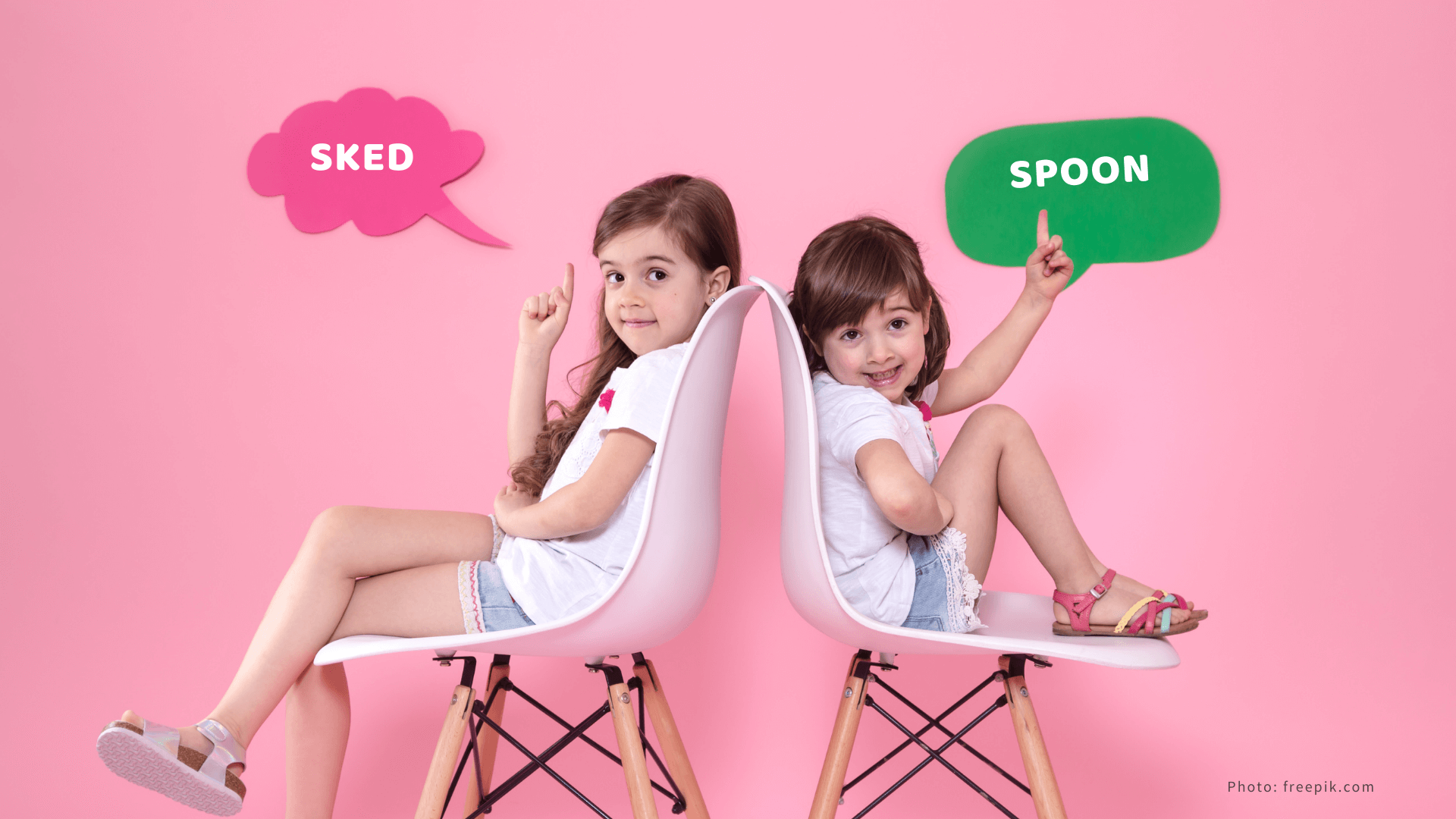
fridge, spoon, table, chair, bed, door, or lamp.
• Write one word in your child’s second language on each sticker.
• Give your child a sticker and let them find the correct object and stick the label on it.
• Say or read the word together as you put the sticker in place.
• Introduce a few new words at a time.
You can also make the game more fun by deliberately putting a sticker on the wrong object.
For example, put “door” on the fridge and see if your child notices the mistake. Let them correct you and move the sticker to the right place.
As your child learns the words, you can gradually remove the stickers and see which ones they still remember.
Let Language Become a Natural Part of Everyday Life
Building vocabulary doesn’t have to mean sitting down for long practice sessions. A few minutes with a ball, a walk home from preschool, or a game using things you already have around the house can create plenty of natural opportunities to use a second language.Adapt the games to your child’s age and language level, making them as simple or challenging as feels right. The most important thing is that your child gets to use the language in a fun and relaxed way.
A babysitter who speaks your child’s second language can also create more natural opportunities to use the language in everyday life – through play, pick-ups from preschool or school, mealtimes, and other activities together.
Want to learn more about our bilingual babysitters? Find out more about how we can help your family. Click here.
